Piece written by Heidi Clark
Daiwa Scholar in Japanese Studies 2024
| In May of this year, I became interested in zines. |
|
| The word ‘zine’ (pronounced ‘zeen’) refers to a type of DIY publication. Its origins are often traced back to 1930s Chicago, with the first issue of the Science Correspondence Club’s science fiction publication, The Comet, which was first published between 1930 and 1933, and duplicated by mimeograph. In the 1950s followed zines about folk music, then those about rock and roll in the 1960s. By this point the introduction of the xerographic photocopier had made zines easier to reproduce and distribute. Zines also provided a space for underground comics movements as a medium through which major comic artists like Art Spiegelman and Jay Lynch found their voice and gained exposure.1 From the 1970s, easy access to photocopying through copy shops meant it had never been easier to become a zinester (maker of zines). The medium was tied to the punk and DIY movements of the 70s and 80s, followed by the feminist punk Riot Grrrl movement in the 1990s and 2000s. It also had a strong presence in the LGBTQ+ community around the same time.2 |
|
| Now, zines are making a comeback in the UK and the anglophone world, thanks to the internet. Easy access to printing and design software, as well as social media, have made zines even easier to produce and share. At the same time, many are (re)turning to physical media as a reaction to how much of our modern lives have gone online. Modern zines are often contrasted with magazines: while magazines are commercially motivated publications financed by selling ad space, zines are a place for non-commercially motivated self-expression in which their creators can freely share their work or ideas. |
|
| At this point, you may be wondering what this history has to do with Japan. Well, zines are having a boom in Japan, too, and have hit the Japanese mainstream. |
|
 |
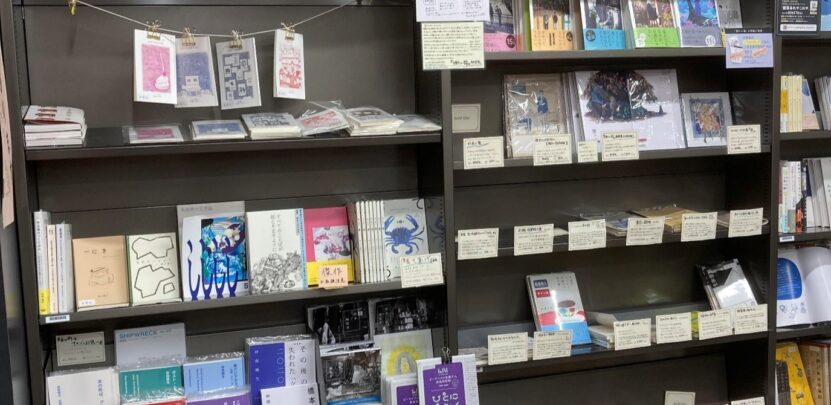
The zine wall in Seesaw Books, Sapporo
|
|
| In May, NHK World reported on the recent popularity of zines within Japan.3 When I travelled to Japan in September this year, I hoped to find evidence of this boom. I was not disappointed. My first stop was Hokkaido, where I returned to a favourite bookshop: Seesaw Books in Sapporo. When I was last here in 2023, the bookshop had stocked a selection of self-published material by local writers and favourite illustrators. Now, in 2025, this section has expanded to a wall of zines, complete with a sign, 『ZINEというニッチな本たち』 [“Niche books known as zines”, pictured above]. In the UK, too, some independent bookshops will stock a section or wall of zines. (Gosh! Comics in London and East Bristol Books in Bristol are just two examples of bookshops with a large section of zines, self-published work and DIY publications.) |
|
| As I travelled to various cities and visited various bookshops, I noticed that there were almost no independent bookshops which didn’t stock zines. When I mentioned ‘zines’ to people, they knew the word and expressed an interest in them. One bookshop in Tokyo, 本の店&company [A Shop for Books and Company], had a shelf of zines signed by their authors. There were even large chain bookshops with zine corners, like Sanseido, whose Jimbocho location had two full bookshelves of zine publications (pictured below). It seemed to me that zines were everywhere. |
|
 |
The corner of zines and little press publications at Sanseido, Jimbocho, Tokyo
|
|
| From what I saw, the zines themselves tended towards a certain type of content: essays in the Japanese style (reflective but not usually heavy, often anecdotal writing). Art and poetry zines also had a strong presence. I was surprised by how many established authors and translators had published one or more zines, alongside their traditionally published work. |
|
| While I was in Tokyo, I had the opportunity to speak with eminent translator Echizen Toshiya, who has published three zines to date. He told me that publishers in Japan currently put out an unsustainably large number of titles, each with large print runs, making titles which are not likely to be bestsellers a risky investment. In contrast, the small print runs and low costs associated with printing mean that zines are a more viable option for certain projects. The freedom to publish without being held to the constraints of a publishing house has allowed Echizen to publish a collection of his translator’s notes spanning his career. This book was the first of his three zine publications on the topic of translation. |
|
 |
Echizen Toshiya’s stall at the Literature Flea Market held in Fukuoka, October 2025. Photo: Echizen Toshiya
|
|
| I have mentioned that printing in Japan has a low financial barrier to entry. One of the first and most striking impressions I had of zines in Japan was that they looked professional, almost as if they had been traditionally published – as if they weren’t zines. They were bound and even had spines. This is uncommon in the UK, where the majority of zines are staple-bound, which is a type of binding representative of the DIY spirit of zine culture. But in Japan, where paperbacks, or bunkobon [文庫本], are a uniform shape and size with a standardised outer and inner cover, anything taller, larger or lacking a paper dustjacket stands out and is easily identifiable as something distinct from a traditionally published book. |
|
| We can definitively say that these publications are zines. Indeed, the Japanese use the exact English word ‘zine’ for these publications, usually in romanised script (usually capitalised as ‘ZINE’) and pronounced with the closest approximation available in Japanese, jīn [ジーン]. Beyond that, they share the fundamental feature of being published non-traditionally, that is, either through small presses or self-publishing. |
|
| But I still wondered whether this form of ‘zine’ represented the same culture and movement I know. In their news story, an NHK reporter claimed that zines offer an authenticity not found in mainstream publishing. However, looking at much of what was labelled as ‘zine’, I could not see how it differed drastically from what was widely available. I saw a few political zines, zines about hobbies or subcultures, but not nearly as many as I would expect, given how counterculture underlies so much of the historic and current UK zine movement, with many zines available in the UK addressing political topics or relating to subcultures. |
|
| When discussing zines with publishing professionals, one editor explained to me that in Japan, zines have entered the mainstream.4 In its current form, zine publishing in Japan exists as an extension of traditional publishing (one with fewer barriers to entry), in that it contains similar publications and similar audiences. However, Japan has had its own movements of countercultural publications. She explained that for publications outside the mainstream, it might be better to look at minikomi [ミニコミ] publications. |
|
| Minikomi, a term which has existed in Japan since the 1960s, is a play on the Japanese term masukomi [マスコミ] an abbreviation of the English term ‘mass communication’. Where masukomi tries to reach and appeal to the masses, minikomi reaches and appeals to few. It was here, the editor told me, that a longer tradition of countercultural solo and group publishing projects could be found.5 |
|
 |
Laetitia Books in Kyoto, a shop with many kinds of zines: professionally bound, staple bound and many entirely handmade
|
|
| This is not to say that the spirit of DIY creation is absent from zines published in Japan. One of the most intriguing projects I came across was from a little press called BOOKSOUNDS, which publishes letters from things that cannot write letters, each one sealed in a brown envelope; I picked up a copy of their letter from a milk jug. Zine fairs are also taking off, the largest being the Literature Flea Market (bungaku furima [文学フリマ] or bunfuri [文フリ]), where groups and individuals can sell their publications. |
|
| While the most easily available zine publications may be those that appeal to the mainstream, there are also exciting and creative projects happening in these spaces. The more space is given to zines and similar publications, the more small makers and presses, and countercultural and subcultural publications, will be able to find their niche. |
|
|
Sources:
1 “The Fanzines That Founded a Movement,” Billy Ireland Cartoon Library and Museum, The Ohio State University, https://library.osu.edu/site/40stories/2020/01/02/fanzines/.
2 River H. Kero, “A History of Zines,” Book Riot, December 2, 2021, https://bookriot.com/history-of-zines/; Chloe Arnold, “A Brief History of Zines,” Mental Floss, November 18, 2016, https://www.mentalfloss.com/article/88911/brief-history-zines.
3 Note: this article has since been removed from their site and YouTube, but was titled “Burgeoning ‘zine scene’ gives boost to Japan’s publishers.”
4 A sentiment reiterated by Kim Kahan in their Japan Times article, Kim Kahan, “A buzzing zine scene across Japan packs passion in multiple formats,” The Japan Times, June 21, 2025, https://www.japantimes.co.jp/culture/2025/06/21/books/japanese-zines/.
5 For more on countercultural and underground Japanese publishing movements of the 20th and 21st Century, see 野中 モモ/Nonaka Momo,
「日本のZINEについて知っていることすべて」[All We Know About Japanese Zines], (Seibundo Shinkosha, 2017). |
|
Written in November 2024