 News
News17 December 2025
Interview with Ishiuchi Miyako: 'I am photographing embodiments of time'
Categorised under: Art & Exhibitions
The Daiwa Anglo-Japanese Foundation invites specialists from a wide range of fields to share their knowledge on the latest important topics. This time, we interviewed the artist Ishiuchi Miyako about her work ひろしま/hiroshima, currently on view at the Daiwa Anglo-Japanese Foundation, as well as the driving forces behind its creation and the power of art.
Can you tell us what originally sparked your ‘Hiroshima’ photographs?
Actually, I had never been to Hiroshima. In 2006 at the Tokyo Photographic Art Museum I exhibited my ‘Mother’s’ series, which I had just shown at the 2005 Venice Biennale. An editor who saw them said ‘How about photographing Hiroshima?’. I was surprised and bewildered to be asked to photograph Hiroshima, and couldn’t immediately reply. I thought about it for a week or so, and then started off quite casually, thinking ‘well, I’ve never been, so I might as well go and see’. Hiroshima had already been photographed by all sorts of people in various different ways, so I thought that even if I went, I wouldn’t find anything to photograph.
What was your impression when you actually went to Hiroshima?
When I visited the Hiroshima Peace Memorial Museum, the possessions of atomic bomb victims there had colour; I had only seen them in black and white. I was tremendously surprised that the colours were still there. I studied textiles at college, so I am more alert to the details of textiles and cloth than most people. The details of those left-behind items and pieces of clothing, both silk and cotton – the quality of those pre-War items is high. I was amazed that even though they had been exposed to the atomic bomb, those high-quality items had survived. And the clothes were really stylish. They were the sort of things I might have been wearing, if I had been in Hiroshima on 6th August 1945. This was how ひろしま/hiroshima started.
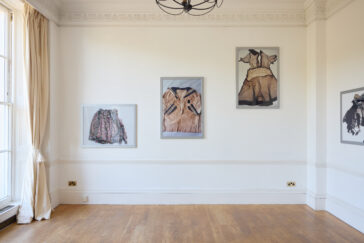
Installation view, ひろしま/hiroshima, The Daiwa Anglo-Japanese Foundation Japan House, 2025. Photo © 2025 Lesley Lau.
In a previous interview you said you want to liberate Hiroshima. What did you mean?
When I went to Hiroshima I had the impression that it was full of peace-related things. The Museum was ‘Peace’, the roads were ‘Peace’, the bridges were ‘Peace’ – the word ‘Peace’ was attached to everything. I wondered why there was so much ‘peace’ in the place where the atomic bomb was dropped. The Hiroshima Peace Memorial Museum should really be the ‘Atomic Bomb Museum’, so it felt a bit strange to me. From conversations with taxi drivers and the like, I had the feeling that the people of Hiroshima were constrained in their thinking. So I thought they ought to loosen up a bit.
What were your thoughts when you started taking photographs?
I’m an outsider, from elsewhere, so I can’t truly approach things from the same angle, or fully comprehend the sadness and pain of atomic bomb victims. So I started from the standpoint ‘I don’t understand’. I have only spoken to one actual atomic bomb victim, but I have a dialogue with those possessions that have been left behind. Those possessions don’t speak, but I am still having a dialogue with those silent relics. When I spread them out under natural light, I think that the missing girl who owned them might come home, might wear this dress. So when I photograph, I try to show them looking smart, looking beautiful. Well, the owner won’t come back, but that’s the image I have in my mind when I take the photographs.
Are there any of those relics that made a particular impact on you?
Yes, Comme des Garçons. I haven’t brought it today, but the first item I photographed was a badly-damaged one-piece dress. It was originally purple, but in the photograph it looks black, and it has a pattern of small polka dots. When I saw it, I thought how fashionable it was. At the time I did not know who had given it to the museum, but I took the liberty of thinking ‘this Comme des Garçons piece is mine’. In other words, I appropriated it. (Later I did some research and found out that when the fashion designer Rei Kawakubo showed her first Paris collection, with the Comme des Garçons ‘ragged look’ based on black, this became known in the West as ‘Hiroshima Chic’.)
What do you mean by ‘appropriation’?
I mean that this is a dress I might well have worn myself. So it is not an archive record; I am not photographing atomic bomb archive material. I am photographing what is in front of me, which is 80 years old. You can’t photograph the past, and you can’t photograph the time when the bomb was dropped. I am photographing these objects now, in 2025, having encountered them in the same space and time in which I live. And I photograph them in my own way, on the basis that ‘this is how I see them’. That’s what I mean by ‘appropriation’.
What are your thoughts on beauty?
Beauty is in the eye of the beholder. Everybody has a different experience of what they feel is beautiful. I am not interested in beauty per se, but objects containing an accumulation of time are beautiful. I find the embodiment of time beautiful.
Do you have a consciousness of yourself as a woman?
The fact that I am a woman is just one factor. I haven’t tended to be overly conscious of myself as a woman, but once I photographed Hiroshima I thought that maybe I can say I am a woman, because otherwise I couldn’t have had the feeling ‘I myself might have worn this one-piece dress’. Until now it has been men who have photographed Hiroshima, and they have mostly taken a documentary approach or an anti-war, pro-peace approach. That’s fine, but I think that’s not all there is to it, and it’s fine to think of Hiroshima in various other ways too. So my photographs have no captions. This is because I want the viewer to think in their own words and to see Hiroshima with their own sense of values.
What do you think about when you are taking photographs?
I don’t think about anything when I am taking photographs. I say hello, and then I take the photo straight away. When I get the prints I choose various options and think about them. After I have finished photographing, I say to Shimomura-san, the curator at the Hiroshima Peace Memorial Museum ‘What do you think that is?’, and that kind of thing, and I talk about my impressions, but basically when I take photographs I work extremely quickly. I think you should work fast when you’re on the spot. You can’t faff about. There’s not time to think. (laughs)
You have been taking photographs of Hiroshima for around 20 years now. What drives you?
When I showed these photographs overseas I realised for the first time that the atomic bombs were dropped on Japan and on Japanese people. Most Japanese people think that the atomic bombs were dropped on Hiroshima and Nagasaki, but it was when I was overseas that I realised the basic fact that they were dropped on Japan. It is the Japanese who are least aware of that fact. Once you think that the bombs were dropped on Japan then it becomes your own problem, and not something to be dealt with just by the people of Hiroshima and Nagasaki.
When I had an exhibition in Edinburgh in 2022 I was surprised to see women and children holding a ‘No More Hiroshima’ rally on 6th August. Nobody is doing that in Shibuya or Shinjuku, are they? The problem of atomic bombs is bigger, and I think it is because we currently face risks of nuclear war that Nihon Hidankyo was awarded the Nobel Prize in 2024. I think it is hard to envisage it as our own problem, but also that it is important how individuals face up to it, and what kind of image they have of it.
Will you continue to take these photographs?
I will keep taking them as long as there are things I want to photograph. Going to Hiroshima is becoming in a sense my life’s work, and it is a place where I encounter new things. This year I went to the museum to take photographs for the first time in three years. Atomic bomb relics are still coming into the museum, but not so many clothes now. This year I photographed children’s clothes, clogs, and a water bottle. I am very happy with the importance of the themes I am dealing with and that I have been able to find my own version of Hiroshima.
My ‘Hiroshima’ is as though an outsider is photographing Hiroshima, so it’s not really Hiroshima. I am photographing embodiments of time. What does it mean that the former possessions of unknown individuals are being so carefully preserved? I think young people should learn more, should think more, about these things, including the nature of atomic bombs. I really look forward to finding out how people in London, people overseas, will view these photographs.
What feelings are incorporated in your London exhibition?
When I learnt that this time it was going to be not a solo exhibition but a group exhibition, I thought very hard about it. Since the theme is Hiroshima, and the eightieth anniversary of the end of the War, I thought it would be good to show female photographers of Hiroshima. Fujioka-san and Sasaoka-san are both from Hiroshima, and I’m an outsider from the Kanto area. So I think we have different ways of thinking about Hiroshima, a different sense of distance, and a different sense of values. And I was very keen to see what kind of exhibition we would produce, including the fact that all three of us are women.
This exhibition themed on Hiroshima seen through the eyes of female artists is a first. Because Fujioka-san and Sasaoka-san are from Hiroshima, their works may have a completely different significance from the photographs I take. We didn’t talk about this much, but I think when you see our photographs and our works, you can sense a shared understanding.
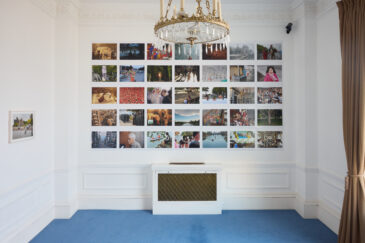
Installation view, ひろしま/hiroshima, The Daiwa Anglo-Japanese Foundation Japan House, 2025. Photo © 2025 Lesley Lau.
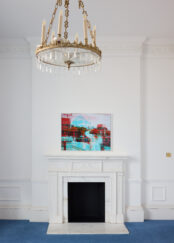
Installation view, ひろしま/hiroshima, The Daiwa Anglo-Japanese Foundation Japan House, 2025. Photo © 2025 Lesley Lau.
You have said you would like to see a similar exhibition in Japan, but is that going to be difficult?
I think there’s a feeling that people don’t really want images of Hiroshima to appear too openly. That might be because they don’t want to touch on the topic, just as atomic bomb victims don’t want to talk about their experiences. But I think all sorts of people should become more involved in the theme of Hiroshima. I think young people should actively photograph Hiroshima and create ‘Hiroshima’ from various standpoints, with various values and significances. Because we are the only country to suffer atomic bombing. By actively creating their own interpretations, young people would come to understand Hiroshima better. And to overstate it a bit, my ‘Hiroshima’ series is one of those ways of thinking.
What are your thoughts on the 80th anniversary of the end of the War?
During the 70th anniversary of the end of the War I had a Hiroshima exhibition at the Getty Museum in New York. These major anniversaries help us to understand, but I don’t care whether it is 80, 90 or 100 years. However many years pass, humans are living things, so we die. But those relics which are preserved so carefully will survive for a long time – for something akin to eternity. Humans are always changing, but perhaps those relics are a necessary part of our fate. So it’s not a question of how many years, but those relics have a kind of immortality.
Wars and conflicts continue incessantly around the world, but how can art contribute to society?
That’s difficult. I don’t think art can contribute. All I can do is show as far as possible to various people how I have lived, and the photographs I have taken. After that, I would like people to think for themselves. I think that maybe I can say ‘this is Hiroshima’, but that’s all I can say.
But I think it may be important to expand one’s perspectives and discover various values. I think Hiroshima offers that possibility in abundance. I think Japan should make more use of the fact that it is the only country to have suffered atomic bombing, but at a national level, it is doing nothing. Art is created by individuals, so I think all we can do is create. I think that holding the exhibition ‘Hiroshima’ in London shows the power of art. I would like people to think for themselves about the fact that there are various ways of looking at this issue. I would like them to look at the works directly.
How can art contribute to passing on memories of the past?
Since hardly anybody is left who remembers, I think the issue is not one of memory. Those who experienced the atomic bombs have many memories, but sadly, they will all die out in the future. I think it’s not a matter of memory, but that it is important to work to expand one’s perspective, and to find one’s own words. So I think there are more ways of doing this. And I think this is something for everyone to think about. I think it is not only those who were involved, those who experienced the bombs, who have the right to speak.
What does Hiroshima mean to you?
To me, Hiroshima means the existence of an embodiment of history, an embodiment of time. The relics in Hiroshima are the embodiment of a uniquely terrible event, an embodiment of time. In a way it has been a pleasure for me to encounter them, but I feel that my photographs, which had their starting point in Yokosuka, were destined to arrive here, and that this is very important.
Interview held on 9th September 2025 at the Daiwa Anglo-Japanese Foundation
Interviewer: Nana Ota, Translator: Jason James