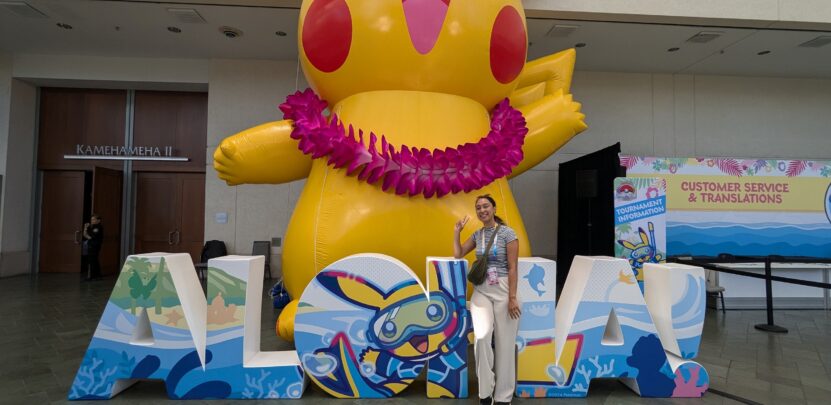
Kendra at the Pokémon Championships in Hawaii, 2024
Scholars' Experiences (Daiwa Scholars in Japanese Studies)
Kendra Evans (2017 Scholar)
I was honoured to receive the Daiwa Scholarship in Japanese Studies in 2017, which allowed me to complete my MA in History at the School of Oriental and African Studies (SOAS), University of London.
The focus of my undergraduate degree was how Japan perceived Africa during the Meiji period, a time when Japan was looking outward for learning.
SOAS was the perfect place to continue this research, and through my course I was introduced to the history of Southern Africa, which in turn inspired me to look at Japanese reports about Great Britain’s war with the Zulu Kingdom, written during the early years of Meiji, for my dissertation.
Thanks to the generous support of the Daiwa Foundation, I was able to travel to the Yokohama Archives of History to read through newspapers from the period and examine how the Japanese reported on the war and how the Zulu were perceived. Having the opportunity to undertake this kind of detailed interdisciplinary research is something I am still immensely grateful for.
Since completing my MA, I now work in Localisation at the Pokémon Company International; a global company, but one where I can make use of my experience with Japan and Japanese every day.
Written in 2025

Kendra at the Pokémon Championships in Hawaii, 2024
Lucinda Fleming-Brown (2021 Scholar)

Lucy at Okinawa Churaumi Aquarium
I received a Daiwa Scholarship in Japanese Studies in 2021, which supported my masters in art studies and curation at Tokyo University of the Arts.
My research explores the history of photography and film in the Ryūkyū archipelago, with a focus on records that attest to fluctuations in the perception of these islands’ territoriality. In 2023 I presented the strand of my dissertation concerned with Nakahira Takuma and the visual politics of the Okinawa Reversion Agreement at a conference hosted by Harvard’s Department of Art, Film and Visual Studies. Over the next two years, I will develop my project as part of the Getty Foundation’s ‘Connecting Art Histories’ initiative, entitled Shared Coasts, Divided Historiographies: Mobilising artefacts, people and ideas in the East Asian Mediterranean.
The Daiwa Foundation’s support was instrumental in allowing me to undertake the fieldwork in Okinawa which facilitated my research. It also gave me the opportunity to develop the practical skills taught on my course through working on exhibitions and catalogues at a range of institutions across Japan. I hope that I am able to maintain the richness and diversity of learning experience that I have found so fulfilling over the last two years now that I have returned to London.
Written in June 2024
Dr Dorothy Finan (2018 Scholar)

I was awarded a Daiwa Scholarship in Japanese Studies for my doctoral research into representations of adolescence in Japanese idol music at the University of Sheffield.
The Foundation were instrumental in helping to organise a planned period of fieldwork in Tokyo in the spring and summer of 2020, which sadly did not go ahead due to the COVID-19 pandemic. Thankfully, with ongoing support, I compiled a corpus of lyrics, conducted remote interviews with songwriters, and was able to publish my research in academic journals.
Punctuated by a period of maternity leave, I successfully defended my PhD thesis in summer 2022 and am now a Lecturer in Cultural Industries at the University of Leeds. Now undertaking leave for my second child, on my return I plan to make my teaching and research a bridge between young people in the UK and Japan, especially my home town of Bradford in the run-up to its year as the UK City of Culture in 2025. I am also excited to start work on a potential monograph based on my doctoral research.
Written in June 2023
Izumi Braddick (2016)
 As a Daiwa Scholar in Japanese Studies, I undertook a DPhil in Archaeology at the University of Oxford. For my dissertation, I adopted a population-based biocultural approach to investigate violence in the prehistoric Jōmon period of Japan. While my research revealed a significantly higher prevalence of violent skeletal trauma than previously reported, the Jōmon people appear to have experienced lower levels of violence than in comparable hunter-gatherer societies in California and Europe. Through the physical examination of Jōmon skeletal remains, I identified several unresolved issues which highlight the need to develop a comprehensive national bioarchaeological database; a project I would love to join and which would strengthen national and international collaboration in my field. While searching for an academic position in Japan, I am undertaking part-time research on prehistoric Japan for SESHAT: Global History Databank, and co-authoring a paper on Japanese decomposition art (kusōzu) with a forensic anthropologist from Oxford and Cranfield Universities.
Written in June 2022
Becki Paterson (2018)
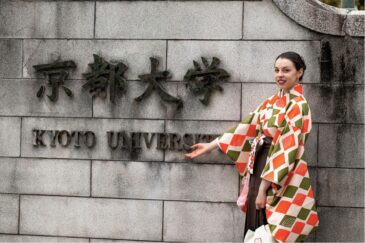
Rebecca at her master’s degree graduation ceremony at Kyoto University
My master’s degree was a taught course that gave a firm foundation in the study of language acquisition and learning.
This was particularly helpful since my thesis focused on reflection strategies as a way to help improve speaking outcomes.
Following my master’s degree, I decided to continue my education at Kyoto University, and begin my PhD, albeit at a different faculty – the Division of Educational and Cognitive Psychology at the Faculty of Education.
My research focus has shifted slightly to the cognitive mechanisms of foreign language speaking anxiety such as the issues of attention and cognitive load.
In order to support myself financially and to gain experience in academia, I am also teaching English at both Kyoto Notre Dame University and Kyoto Prefectural University where I teach speaking-heavy courses according to my own curriculum.
Here, I have many opportunities to utilise my Japanese skills to ensure that my students are engaged and fully understand. Furthermore, I see myself as a role model for others in having mastered Japanese as a foreign language and in having been successful as a young woman in my career in Japan where women’s career opportunities are limited.
Written in June 2021
Elizabeth Wormald (2016)

At the Yayoi Kusama: My Eternal Soul exhibition at The National Art
Center in Tokyo in 2017
As a Daiwa Scholar in Japanese Studies I undertook an MA in International Culture and Communications Studies, specialising in Visual Culture, at Waseda University. I focussed my research on Japanese women photographers, analysing their use of self-portraiture as a tool to disrupt the traditional male gaze in Art History.
Following my graduation in spring 2019 I found an internship at Christie’s Japanese Art Department, London, where I developed my understanding of the art market, and learnt a great deal about Ukiyo-e. In August 2019 I began a full-time position at Roseberys Fine Art Auctioneers where I work between the Japanese Department and the Prints and Multiples Department as a Junior Cataloguer. My studies have allowed me to work professionally with two specialisms – both Japanese fine art and contemporary international art, working with pieces by a range of artists from Hokusai and Yayoi Kusama to Picasso and Bridget Riley.
Written in June 2020
Harriet Cooke (2017)
 During my two years as a Daiwa Scholar in Japanese Studies, I lived in Tokyo, studying an MA in International Relations at the Graduate School of Asia-Pacific Studies, Waseda University.
My research focused on influencing factors on Japanese womens’ choices on birth and child-rearing, guided by Life Course theory. I interviewed nine women from the Greater Tokyo area, and through these interviews found evidence to support the presence of gender constraints which had and continue to have, a significant impact on the lives of my informants. Despite recent steps by the Japanese government to reform the workplace, these were deemed as ineffective ‘band-aid ‘policies that did little to address the underlying issues of tekireiki age norms and social pressures that equated marriage with motherhood and working full-time as incompatible with child-rearing.
Following my graduation from Waseda, I was invited to present the findings of my thesis at the British Association of Japanese Studies conference at Sheffield University in September 2018. It was a delight to be able to return to the university where I first studied Japanese at undergraduate, and a privilege to be able to present my research to faculty members who had previously taught me and to meet so many fantastic specialists in the Japanese Studies field.
Currently, I work at Hitachi Rail, Ltd., as a Business Management Graduate, responsible for M&A origination, transaction management, strategy mapping and KPI analysis.
Written in June 2019
Kara Juul (2015)
 Kara successfully completed her MPhil in Modern Japanese Studies in 2016, and is in the second year of her DPhil at St Antony’s College, Oxford. Her research explores the ‘gender gap’ in mathematics achievement and advancement in Japan, particularly focussing on how key stakeholders such as teachers and educational policymakers understand this issue. Japan provides an interesting conundrum: it scores highly in international benchmarking tests for mathematics such as PISA and TIMSS (15 year olds), yet girls underperform significantly compared to their male classmates and have much lower levels of self-confidence and interest in mathematics.
As part of her research Kara investigates why, despite a goal of the ‘Abenomics’ strategy being to encourage women into economically vital STEM (science, technology, engineering and mathematics) professions, the gender gap in mathematics attitudes and achievements seems to have been largely ignored by many levels of Japanese society. Kara has recently completed her second round of fieldwork and is planning her third.
Written June 2018
Thomas Monaghan (2016)
 Thomas Monaghan, a 2016 Daiwa Scholar in Japanese Studies, recently completed his year at Tokyo University as a Postgraduate Foreign Research Student. He has an MA (Scot) in History from the University of Edinburgh and an MA in Japanese Studies with Intensive Language from SOAS, University of London. Between degrees he spent two years in Naoshima, Kagawa Prefecture as an Assistant Language Teacher on the Japan Exchange and Teaching (JET) Programme.
While in Japan, Thomas explored the significant historical role that the Satsuma Domain (present-day Kagoshima) played between 1830 and 1877 in the overthrow of the Tokugawa Shogunate and the establishment of the Meiji Government. He researched the origins and paths of Satsuma’s modernising leadership on the one hand, symbolised by Nariakira Shimadzu (1809-1858), the promoter of Satsuma’s early industrialisation, and reactionary militarism on the other, represented by the violent backlash in 1877 against the Meiji government’s modernising reforms. Thomas’s PhD at Yale is further delving into why Satsuma followed a separate path to the rest of Japan and what this reveals about the nature of the Japanese polity during the upheavals of the 19th Century.
Written June 2017