 News
News18 February 2025
Nepali students in health and social care sectors in Japan and in the UK
Dr Radha Adhikari, University of the West of Scotland, shares the findings of a research trip to Japan, supported with a Daiwa Foundation Award, which looks at how Nepali Higher Education students in the UK and Technical Trainees in Japan contribute to the labour shortages in these countries.
Project Partners:
Professor Jeevan R Sharma (University of Edinburgh, UK) and
Professor Reinaruth D. Carlos (Ryukoku University, Kyoto, Japan)
Nepali students in health and social care sectors in Japan and in the UK: the global healthcare labour shortage, international recruitment and migration governance
Both Japan and the UK are experiencing labour shortages in the health and social care sectors. In recent years, Japan and the UK have become very attractive countries for Nepali young people to work and study, and the number of Nepalis going there is increasing every year. Even during the peak of the Covid-19 pandemic, when many aspects of international travel were halted, the flow of Nepali students travelling to Japan and the UK for education, and/or training, continued.
Our study explores Nepali students’ migration process: their migration intentions and their current study and working and living conditions. This reflection explores our recent experience of engagement with young Nepali students, who are working in the health and social care sectors in Japan and in the UK.
The topic under investigation has been our interest for over a decade now. After several rounds of online meetings and ongoing conversations on the research topic, we designed the research protocol, conducted a feasibility study, and obtained research ethical clearance from the University of the West of Scotland, and Ryukoku University Kyoto. We began our field work in late March 2024. Professor Carlos from Ryukoku University, visited Scotland, and we had in-person planning meetings in Edinburgh, and went on to engage with Nepali higher education students, who are studying and working in the health and social care sectors in the Glasgow area.
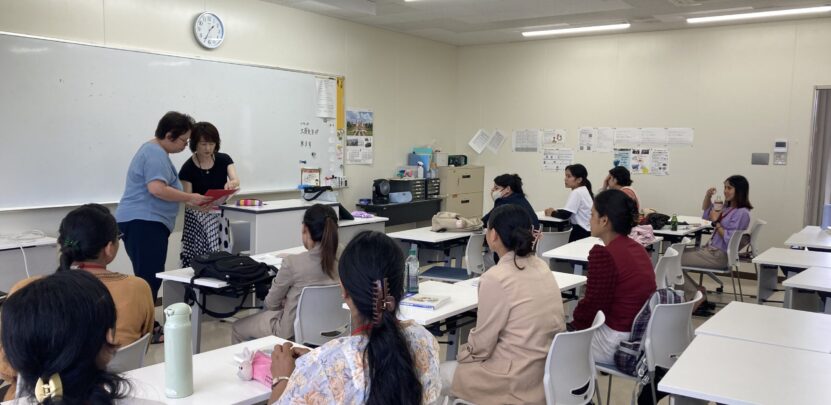
In June and July 2024, Dr Adhikari and Professor Sharma visited Japan to work with Professor Carlos. There we met with Nepali Technical Trainees, Japanese language students, and Japanese stakeholders in Osaka, in Fukuoka, and in Nagoya respectively, and gathered valuable insights on the topic. We also visited Kyoto University and interacted with post graduate students studying various subject areas on Nepal, and with Japanese scholars based at Ritsumeikan University, and the Institute of Development Economies, whose research is on the international migration of healthcare workers, to gain a wider and deeper understanding of Nepali migration to Japan, and thus paving our way for future research collaborations.
Preliminary findings: given the considerable differences in both countries’ political and migration history, and their current socio-cultural and political contexts, nevertheless we found many similarities in Nepali youths’ migration to Japan and the UK. The main migration intention is to work and search for future work outside Nepal. Some further insights, are detailed below.
Levels of education and potential costs determine migration destinations: From the discussion with our participants, it became very clear that the level and type of education completed at home, what family support is available, and the potential costs of the process, are key deciding factors for migration destination. To gain admission to Higher Education Institutions (HEIs), and secure a student visa for the UK, and other English-speaking countries, candidates need to have English language competency, and preferably higher education or professional education. For example, as regards those students we met in the UK, the majority of them attended an English medium private school in Nepal, and had learned English there.
All of our participants in the UK were already fully qualified nurses. They also had spent significantly more money in the migration process. In contrast to Nepalis in the UK, young Nepalis in Japan learned Japanese language outside their mainstream education in Nepal. However, for Japan, the migration costs were considerably less, therefore young people from wider socio-economic and education backgrounds could afford to go to Japan. Opportunities to go to Japan are more easily accessible to those who are unable to pay the huge migration-related fees required to go to English speaking countries. For those who are not able to invest much money in their overseas education migration to Japan is preferable. We also learned that eligibility for a visa is dependent on candidates proving they have enough money, or financial support, to survive easily in their destination countries.
Studying, working and earning for survival: In both countries, young Nepalis were attending training/ education programmes. In theory, international students are allowed to work part-time, up to 28 hours in Japan and 20 hours in the UK, to supplement their living costs. In reality, their part-time earning becomes their primary income, which is to cover their fees, and everyday expenses. The only difference is that course fees are cheaper in Japan, and much more expensive in the UK.
Earning styles: “Anyhow Paisa Kamau” or earn money in whatever way possible – mainly by taking work in addition to the government’s recommended hours was a common phrase we heard in Japan. However, despite considerable differences in workplace regulation, and working culture, in these two countries, we learned that there are many similarities in young Nepalis’ working and earning styles. The most obvious one is that a vast number of participants revealed that they normally work much more than the recommended hours, and earn more for survival. Participants in both countries indicated that there are informal employment practices, of which employers are fully aware. Immigration guidelines, and formal practice, propose that students should work only a certain number of hours during their study terms. However, there is an informal employment culture in both countries, which allows them to work extra hours, and for which they are paid informally. A common description in Japan for formal versus informal payments is ‘bank cash’ versus ‘hand cash’. When they work formally, their earnings are paid into their bank account, hence the ‘bank cash’. But if they work additional hours informally, they get paid ‘cash in hand’ in the UK, described as ‘hand-cash’ in Japan.
Despite their initial struggle to settle in their destinations, young Nepali migrants in Japan and in the UK expressed their intentions to stay in their new destinations for a while: to learn and earn, and shape their futures. They hope to achieve their aims, which are to progress professionally and financially, experience the wider world, and support their family back home in Nepal.
For Nepali nurses in the UK they suggested that they would like to obtain their professional licences (Nursing and Midwifery Council registration) to be able to practice nursing, and also achieve further education qualifications.
For Nepalis in Japan, their possible future pathways were less clear, as participants did not have a professional education, unlike those studying/working in the UK. However, all of them knew about the labour shortages in Japan, and potential future opportunities there. Many were considering care work, with others stating they would consider some training in the automobile sector, or in IT, and/or in the anime sector. Being still very new to the country, they were in the process of settling in.
The main points, discussed above, provide further evidence that labour shortages in the health and social care sector in Japan and in the UK, are only too real, with international students and technical trainees providing some relief in this ongoing crisis. International opportunities for young Nepalis in the Japanese and British health and social care sectors are also expanding, witness the growing number of migrants entering these sectors in both countries.
We further realised that protecting migrants’ welfare remains a critical issue in both countries, as the current employment guidelines are not effective. The young Nepalis we met in Japan and in the UK revealed they have to work extra hours for survival, and often going beyond the government guidelines. Payment rates for direct ‘cash in hand’/ ‘hand cash’ are lower than ‘bank cash’ rates. They also shared that employers are fully aware of international students’ economic vulnerabilities, and use this knowledge ‘to support’ as well as exploit them. We had noted too that participants had been overworked and were visibly exhausted. They were required to attend language and other training sessions, which were not their main priority. We feel that the system, and all individuals within it, would benefit from a proper review of working times, and the pay and benefits for international workers. Healthy and happy workforces make better teams and contribute to better outcomes.
We are very grateful to the Daiwa Anglo-Japanese Foundation for this opportunity and for making this work possible.