Events category: Seminar

12 March 2024

Generative AI and the creation of Large Language Models (LLMs)

The release of ChatGPT and the broader advent of generative AI was a shocking wake-up call to the world. OpenAI introduced its software in November 2022 and gained over a hundred million registered members within two months. Since then, generative AI has begun to show us the scope of its potential, affecting several industries and changing ways of working, businesses, and ultimately society. As a leader in both AI innovation and investment, Ren Ito provided a brief overview of the current state of generative AI, before diving deeper into his own unique insights about the industry, introducing notable examples from the UK and Japan and highlighting the importance of international cooperation to deal with existing and emerging challenges and problems.

Fully bookedMore info

5 September 2023

NATO and Japan

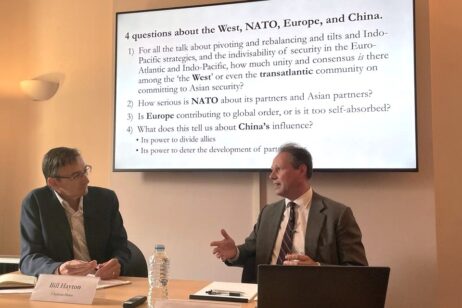
NATO’s plan to open a liaison office in Tokyo, an idea strongly criticized by China, seems to have been shelved after the French government expressed its opposition. The Western military alliance led by the US seeks to deepen connections with Asia-Pacific allies, prompting concern among some of its member states. In this seminar, Dr Philip Shetler-Jones talked about the impact that a NATO liaison office in Japan might have on the region’s geopolitics and security, and its challenges, and analyzed what is really behind NATO’s plan for an office in Tokyo.

Fully bookedMore info

5 July 2022

The political economy of inflation in Japan since the Ukraine War

The Ukraine War has exacerbated the global pressures of inflation on items from food to energy, with huge consequences for the political economies of the G7 and European countries. In this session, the speaker discussed whether Japan’s decades-long issues related to “deflation” going to be “solved” by inflation, and also addressed the risks and opportunities arising from this round of inflation, such as climate action, wage hikes, the pension system. Following this, he gave an overview of recent Chatham House events related to the Ukraine War, and then discussed the role of thinktanks in general.

1 February 2022

Supporting older people in the community in England and Japan

Demographic ageing is forcing many developed countries to abandon generous public welfare services. But this change does not mean giving up on welfare provision and adopting libertarian policies that leave almost everything to self-help. Many countries are making more positive use of welfare provision by residents and charitable organisations to support the lives of older people in the community. Looking at the cases of England and Japan in this seminar, Dr Daisuke Watanabe introduced the background, current situation, and challenges for contemporary pluralistic welfare services for older people. He also discussed the costs and other burdens of community-based mutual aid activities, and their sustainability.

17 February 2022

Reaching Net-Zero Emissions with Ocean Renewable Energies, and Japan's ocean wave energy potential and stability

The energy crisis, climate change impacts, and hence, commitments to net-zero emission have brought renewable energies into focus. Ocean renewable energies have been considered a promising alternative to fossil fuels in areas exposed to open water bodies. However, climate change may alter the available resources and suitable locations for energy extraction. In this seminar, we focused on the wave energy potential in Northeast Asia and Japan and its stability under a changing climate, and discussed the suitable areas for future planning considering the long-term change of resources in line with Sustainable Development Goals (SDGs).

Fully bookedMore info

2 November 2021

UK-Japan Security Cooperation in a Historical Context: From Afghanistan to Afghanistan

The visit to Japan by UK Carrier Strike Group 21 marked an important step towards the deepening of UK-Japan security cooperation. It is seen as an implementation of the UK’s recent “Indo-Pacific tilt” in foreign policy, but also exists in a much larger historical context: two wars in Afghanistan fought by British forces, in 1878-1881 and 2001-2021, both accidentally introduced closer security cooperation between the two island powers. What are the implications for the future of UK-Japan relations? Professor Yuichi Hosoya gave a historical perspective, before Paul Madden CMG, former British Ambassador to Japan, commented and moderated a discussion with the audience.

10 March 2020

British Management of Territorial Disputes and Lessons for the Japanese Government

The three territorial disputes Japan has with its neighbours remain important factors of discord in Northeast Asia. They originated in Japan’s imperial expansion in the past and remain unresolved because of its sensitive public opinion in the present. The United Kingdom has richer experience of territorial disputes. It has settled many territorial disputes in the past and maintains five territorial disputes to date, from which the Japanese government should take some lessons. Professor Tetsuya Toyoda discussed the UK’s example and how it may affect Japan’s legal claims to Senkaku/Diaoyu and Dokdo/Takeshima.

11 February 2020

Whose right to life? The ethics of suicide prevention in the UK and Japan

“Who has the right to prevent suicide?” Following a rapid increase in suicides in Japan during the 1990s, annual suicide numbers have since reduced from over 30,000 to just above 20,000 in recent years, while in the UK, suicide numbers are at their highest levels since 2002. In this seminar with Prof. Richard Huxtable and Dr Satoshi Kodama we discussed the ethical justifications for suicide prevention, both its end and means. We explored questions such as: ‘Should all suicide attempts be prevented or is there a case for “rational suicide”?’

20 February 2020

Fathoming Fragility and Seeking Stability: Understanding Prime Ministerial Leadership in the 21st Century

This seminar explored the phenomenon that the prime minister is becoming stronger in Japan at the same time that the UK prime minister seems to be weakening. Traditionally the Japanese prime minister was regarded as a transient, weak, compromise figure but this has changed in recent years. In the UK, intra-party and executive-legislative dynamics have shifted in a way that has weakened the prime minister. The seminar explored factors such as the broader socio-economic context, the core executive, party relations, individual styles and skills, celebrity politics and psychological factors.

27 November 2019

How Japan sees China

What does China’s Belt and Road Initiative (BRI) mean for Japan? China’s infrastructure investments in Asia, Africa, and Europe pose challenges to Japan’s political and economic influence, and yet it seems as though Tokyo has no choice but to accept the BRI system. In this talk, Dr Taku Tamaki explored the possibility of borrowing the ideas of Japanese philosopher Tetsurō Watsuji as a way to start conceptualising what BRI means for Japan. Watsuji’s idea of aidagara suggests that human existence comprises a complex web of inter-relationships involving subject-subject, as well as environment-subject, inter-relationships; thus we can view BRI as representing Japan’s aidagara with the international environment.

Toggle navigation