今までのイベント

1 May 2019

Tokyo 2020 and Japan’s Soft Power

Amidst the flux of the liberal international order, Japan’s public diplomacy, which relies solely on its cultural uniqueness, is inadequate. Professor Yasushi Watanabe of Keio University proposes new principles for an age where the diplomatic sphere is expanding from negotiation tactics to agenda setting and norm setting. In this presentation, Professor Watanabe reviewed the trajectory of Japan’s public diplomacy, its challenges and possibilities, with particular attention to the Tokyo 2020 Games.

30 April 2019

Populism in Japan

Japan seems to be a relatively stable democracy at a time of rising populism around the world. Japan has successfully advanced free trade initiatives in the Asia Pacific region and with Europe and Shinzo Abe is soon to be the longest-serving prime minister in the country’s history. Yet, it by no means follows that Japan is immune to populistic impulsions. This event explored how populism plays out in public discourses across society, politics and foreign relations in Japan today and how the case of Japan can be situated in a global context.

25 April 2019

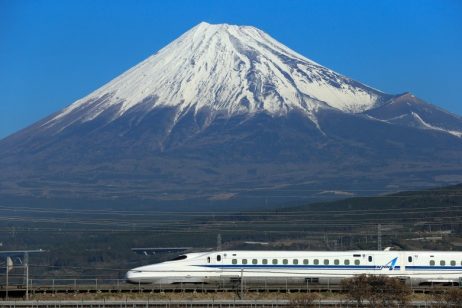
Shinkansen and the Tokyo Olympics

The Shinkansen, or bullet train, is an icon of Japan. The first Shinkansen line, which opened in 1964, coincided with the previous Tokyo Olympics and marked the welcoming back of Japan into the international community after the war. As the Olympics returns to Tokyo, whilst Japan is facing new challenges, the country is still willing to adopt a long-term approach and invest in new infrastructure. This seminar discussed the development of the Shinkansen between the 1964 and 2020 Olympics, looking at the history of transport in Japan and the technological developments of the railways.

Fully bookedMore info

17 April 2019

The Ghost of Namamugi

In 1862 a British merchant was killed by samurai, in uncertain circumstances, at Namamugi – a quiet village near Yokohama. One year later, a British fleet bombarded the port of Kagoshima in response, reducing much of the city to ash. In this book launch, Robert Fletcher re-examined this turbulent moment in the history of relations between Britain and Japan. He explored how the death of a young merchant led to the bombardment of a Japanese city, and how different accounts of precisely what happened at Namamugi have circulated ever since.

16 April 2019

Private View: JIZAI by Haruo Mitsuta

The Private View was an opportunity to have a first look at the works of the acclaimed Japanese artist Haruo Mitsuta. Mitsuta is the only living artist who makes contemporary Jizai Okimono (“articulated animals”) – flexible animal figures made from metal pieces, which can replicate the movements of the original animals. Mitsuta will be showcasing some of his most impressive and startlingly realistic pieces in this exhibition. During the evening Dr Clare Pollard, University of Oxford, gave an introduction to Jizai Okimono.

28 March 2019

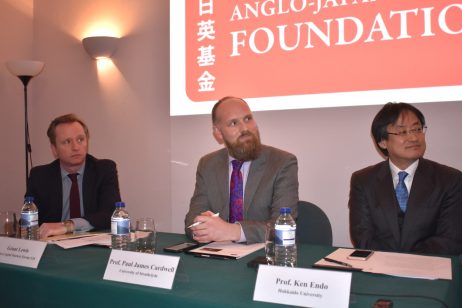
What Brexit Means for Japan

As Brexit day on March 29th approaches, Japanese companies based in the UK have started preparing for a no-deal scenario. The trend of shifting some operations out of the UK seems to be gaining momentum among Japanese companies, which may have a long-term effect on UK-Japan commercial relations. In this seminar, Professor Ken Endo of Hokkaido University analysed the impact of Brexit on UK-Japan relations and EU-Japan relations. Grant Lewis, of Daiwa Capital Markets Europe Ltd, then explained the economic impact of Brexit from a UK perspective.

Fully bookedMore info

22 March 2019

The Englishman who saved the Japanese cherry

In this book launch, Naoko Abe introduced her latest book “‘Cherry’ Ingram: The Englishman Who Saved Japan’s Blossoms”. Collingwood Ingram, known as ‘Cherry’, visited Japan in the early twentieth century and fell in love with cherry blossoms. He dedicated much of his life to their cultivation and preservation, becoming a leading expert on the subject. This book is a portrait of ‘Cherry’ Ingram, a story of Britain and Japan in the twentieth century and an exploration of cherry blossoms.

Fully bookedMore info

20 March 2019

Sustainable Development Goals: Japanese and UK approaches

Since their adoption by the United Nations in 2015, the Sustainable Development Goals have been embraced with remarkable enthusiasm by the Japanese government and institutions. In this seminar, Fumie Imabayashi of the Japan Science and Technology Agency explained the background to this stance. Her talk was followed by a presentation by Dr Chris Anastasi who has over 30 years’ experience of encouraging longer-term strategic thinking on global development issues.

19 March 2019

Artist Talk: Shuhei Yamada in conversation with Jeremy Millar

Shuhei Yamada will be discussing his work which is on display at the Foundation. In his early works, Yamada focuses on eliminating from images the key objects that enable the viewer to easily understand them. Yamada suggests that viewers should read various meanings into his art. After the 2011 Tohoku Earthquake and the accident at the Fukushima nuclear power plant, he became interested in exploring the absurdities of the society that surrounds us. In recent years, his work has included not only photography and videos, but also 3D art and installations.

14 March 2019

Foreign Refugee Flows into Japan: Asylum Seekers’ Circuitous Path

This seminar attempted to explore the paradoxical ways that Japan has positioned itself on the issue of refugees. The speaker used video clips from extended narrative interviews with current asylum seekers in the Tokyo area to discuss these paradoxes. The video clips allowed the asylum seekers to speak for themselves and showed us the circuitous path taken by asylum seekers, as they navigate Japan’s arcane immigration and support systems, try to find and keep work, endure incarceration in detention centres, and struggle with the vagaries of community connections and political positionality.

13 March 2019

Prevention of Recidivism: Trends in Japanese Criminal Policy

One of the most serious current issues in criminal policy in Japan is the prevention of recidivism. In this talk Andrew Watson discussed the basics of the Japanese probation system and the challenges it faces, with comparisons to probation in England and Wales. Taichi Yoshikai then discussed the 2016 “Act to Promote Prevention of Recidivism,” and the current plan which was drawn up in 2017 by the Cabinet in response to the Act, with consideration of key characteristics of the Japanese criminal justice system.

Toggle navigation