Events category: Talk

23 October 2026

Shinya Tsukamoto in Conversation with Professor Alastair Phillips

In this webinar, moderated by Professor Alastair Phillips, acclaimed filmmaker Shinya Tsukamoto will discuss his latest film, Mr. Nelson, Did You Kill People?, which recently received the Leoncino d’Oro Award at the 83rd Venice International Film Festival. He will share insights into his work, the concepts and background behind the film’s creation, as well as the inspiration behind the work.

3 November 2026

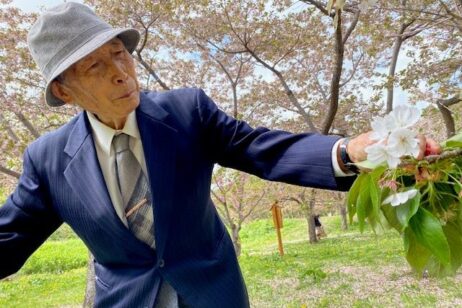
Can Cherry Trees Bring Hope to Ukraine?

Masatoshi Asari, a 95-year-old Japanese cherry-tree creator who has spent more than 50 years sending sakura overseas, will make his final ‘gift of peace’ next spring when his ornamental cherries go to Ukraine in 2027, five years after the war started. Throughout his life, Asari has regarded cherry blossoms as symbols of peace, friendship and reconciliation.
How can Japanese cherry trees support humanitarian activities in Ukraine, a country devastated by war? Can cherry trees be a testament of hope there? Tracing the human stories behind the trees, this talk will explore these questions.

14 September 2026

Archaeology of the Future II

In this talk, Paris-based Tsuyoshi Tane, one of Japan’s most prominent architects, shared insights into his major architectural works, including the Hirosaki Museum of Contemporary Art, and the Estonian National Museum, as well as ongoing projects such as 388 FARM and the new main building of the Imperial Hotel, scheduled for completion in 2036. He also shared his perspective on what architecture can be, drawing on his architectural philosophy and approach to design.

Booking closedMore info

15 July 2026

The Japanese Fiction Boom: From the publisher’s desk

Over the last few years Japanese titles have taken up half of the slots on translated literature bestseller lists. What caused this sudden wave of Western interest in Japanese fiction across all genres? This talk went behind the perfect storm of reasons that has made Japanese literature the biggest publishing trend of recent years. It also tried to answer the question of what aspect of reading experience the Western public was missing and why Japanese writers are uniquely positioned to fill that gap. What are the remaining Japanese titles that are still being overlooked? It tried to share future predictions as well.

Fully bookedMore info

20 July 2026

Isn't London a catalyst for storytelling?

In this talk, moderated by Jonathan Watkins, Taihei Soejima presented artworks that explore histories in which multiple truths coexist, employing the contrasting media of generative AI and analogue film, alongside portraiture capturing individuals in multicultural communities undergoing gentrification. He reflected on how his ‘unresolved experiences’ have been transformed into his current artistic practice, with London acting as a catalyst.

Fully bookedMore info

28 January 2026

Translation and the borders of contemporary Japanese literature: Inciting difference

In this talk, Vicky Young discussed her monograph, ‘Translation and the borders of contemporary Japanese literature: Inciting difference’. The book examines contemporary debates on such concepts as national literature, world literature, and the relationship each of these to translation, through the lens of modern Japanese fiction. By focusing on so-called marginalised voices from within Okinawan literature and zainichi literature written by ethnic Koreans, and other “trans-border” works, this book reveals tensions and blind spots that serve to decentre the image of Japanese literature presented to the world in translation, while opening critical connections to wider questions of multilingualism, decolonisation, historical revisionism, and trauma that are so central to contemporary literary studies.

Fully bookedMore info

7 October 2025

Celebrating the Flora of Japan

Japan’s landscapes are as diverse as they are beautiful – from Hokkaido’s alpine meadows to the subtropical forests of Okinawa. This variety of habitats supports an extraordinary range of plants, with a quarter found nowhere else on Earth. In this talk, Ben Jones, Arboretum Curator at the University of Oxford Botanic Garden and Arboretum, shared stories and discoveries from over a decade of botanical fieldwork in Japan. Blending science, conservation and cultural heritage, this presentation celebrated Japan’s unique plant life and highlights why protecting it matters for both nature and people, at home and around the world.

Fully bookedMore info

8 September 2025

The Impact of Women on Japanese History

Japanese history is not all shoguns and samurai: women played a prominent role. In the early centuries Chinese envoys called the part of Japan they knew ‘Queen Country’ because there were so many female rulers. In her talk Lesley Downer told the story of Himiko, the shaman queen, and of some of the early empresses, along with brilliant and powerful figures such as Nene-dono, Hideyoshi’s wife, who continued to wield power from behind the throne, and women writers and artists who helped shape Japanese history. By discussing the many roles women have played throughout Japanese history, Lesley provided a new and refreshing perspective on that history, while putting paid once and for all to the egregious stereotype of the ‘submissive geisha’.

Fully bookedMore info

15 May 2025

Talk in Edinburgh: Voices of Nagasaki Atomic Bomb Survivors

In this talk in Edinburgh, Chiyoko Motomura, who was six when the atomic bomb was dropped on Nagasaki, described what happened on the 9th of August 1945, along with her personal memories. Dr Masao Tomonaga, who was only two and devoted his career to studying the medical effects of the atomic bombs, gave his view of the lessons we need to learn and asked what we can do to help. Finally, Tomoko Ōtaki, a second-generation A-bomb survivor, shared her activities including her views about the role of the second generation.   

14 May 2025

Talk in Cambridge: Voices of Nagasaki Atomic Bomb Survivors

In this talk in Cambridge, Chiyoko Motomura, who was six when the atomic bomb was dropped on Nagasaki, described what happened on the 9th of August 1945, along with her personal memories. Dr Masao Tomonaga, who was only two and devoted his career to studying the medical effects of the atomic bombs, gave his view of the lessons we need to learn and asked what we can do to help. Finally, Tomoko Ōtaki, a second-generation A-bomb survivor, shared her activities including her views about the role of the second generation.

Toggle navigation